Finland is once again the world’s happiest country out of 149 countries, followed by Iceland and Denmark, through a year marked by the pandemic. The United States ranked 14th, moving up from the 18th spot. A key factor in top countries’ happiness relates to people’s trust in each other and their government.
In the past, The World Happiness Reports, which is a publication of the Sustainable Development Solutions Network, were primarily based on levels of GDP, life expectancy, generosity, social support, freedom and other factors. However, this year, the report focused on the effects of COVID-19 and how people all over the world have fared. The report:
Focused on the effects of COVID-19 on the structure and quality of people’s lives,
Described and evaluated how governments all over the world have dealt with the pandemic.
“This whole report focuses on the effects of COVID-19 and how people all over the world have fared,” the team behind the report said.
Mental health and social/emotional well-being
Mental health has been one of the casualties both of the pandemic and the resulting lockdowns, according to The World Happiness Report. As the pandemic struck, there was a large and immediate decline in mental health in many countries worldwide. There has been greater economic insecurity, anxiety, disruption of every aspect of life, and, for many people, stress and challenges to mental and physical health.
The early decline in mental health was higher in groups that already had more mental health problems — women, young people, and poorer people. It thus increased the existing inequalities in mental well-being. At the same time, as mental healthcare needs have increased, mental health services have been disrupted. This is serious when we consider that the pandemic is likely to leave a lasting impact on the younger generation.
On the positive side, the pandemic has shone a light on mental health as never before. This increased public awareness bodes well for future research and better services that are urgently needed.
There has been surprising resilience in how people rate their lives overall. Trust and the ability to count on others are major supports to life evaluations, especially in the face of crises. To feel that your lost wallet would be returned if found by a police officer, by a neighbor, or a stranger, is estimated to be more important for happiness than income, unemployment, and major health risks (see Figure 2.4 in chapter 2)
“We must aim for well-being rather than mere wealth, which will be fleeting indeed if we don’t do a much better job of addressing the challenges of sustainable development,” said Jeffrey Sachs, director of the Sustainable Development Solutions Network. “The pandemic reminds us of our global environmental threats, the urgent need to cooperate, and the difficulties of achieving cooperation in each country and globally. We need urgently to learn from Covid-19.”
Health officials say travel risk is low for those fully vaccinated
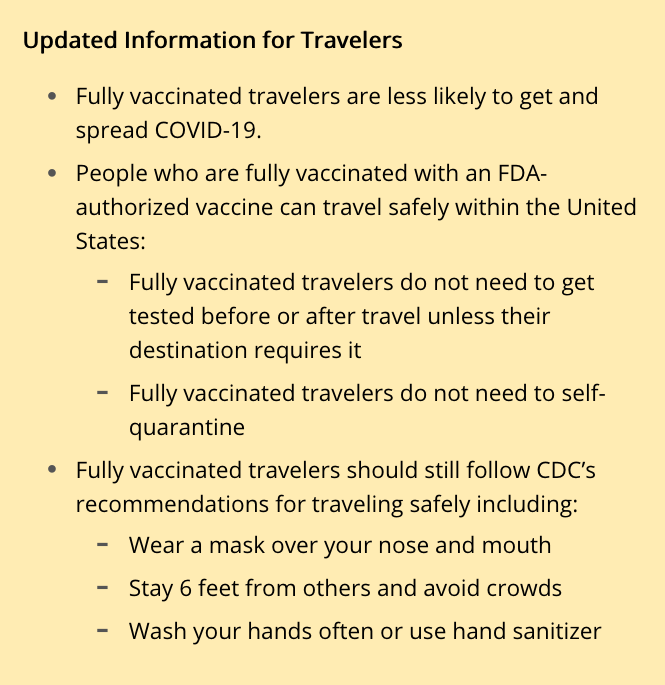
The Centers for Disease Control and Prevention announced that people who are fully vaccinated can travel within the US with a low risk of exposure to the COVID-19 virus.
The new guidance recommends that travelers continue to wear masks and socially distance, and advises that fully vaccinated travelers entering the US from overseas continue to test for infection.
Breaking: People fully vaccinated against Covid-19 can travel without putting themselves at serious risk as long as they wear masks and take other precautions, the CDC said, relaxing its blanket stance against travel https://t.co/X1BgR7IdTw
The shift comes as new studies have shown that Covid-19 vaccines have been effective in real-world conditions at reducing the risk of infections with or without symptoms.
CDC Director Dr. Rochelle Walensky said that fully vaccinated people don’t need to get a COVID-19 test before or after domestic travel—and don’t need to self-quarantine following travel. Travelers who have been fully vaccinated also don’t need to get tested prior to international flights unless that is required by the destination, and they don’t need to self-quarantine when they return to the U.S.
As aspects of our lives continue to move to digital spaces, it’s more important than ever to make sure you are taking the right steps to protect yourself. No matter the type of online account, your first line of defense is often your login password.
1. LONGER IS STRONGER
The longer and more complex you make your passwords, the stronger they’ll be in the long term. Short, simple passwords are often much easier for hackers to crack. Aim for at least 8-12 characters, and consider these other basic guidelines for how to create strong passwords:
Use a combination of upper and lower case letters, numbers and symbols.
Avoid easy, simple phrases like “Password123” and never use personal information (birth dates, pet names, etc.)
Random is better: pick a strange phrase and replace letters with numbers or symbols where you can. Have some fun with it!
2. CYCLE PASSWORDS OFTEN
Larger companies like Google and some financial institutions often prompt users to change their passwords after a certain period of time. A good rule of thumb is to rotate passwords at least every six months. It might feel like a chore to go through every single online account. But when you’re considering sensitive personal and financial information, what’s an extra 15 minutes twice a year to protect yourself?
3. NEVER USE THE SAME PASSWORD FOR MULTIPLE ACCOUNTS
We’ve all been guilty of it. You craft one really strong password and decide to use it for every account. Sure, it’s convenient and may help you save time during your day. But, in the event of a breach, it’s not just one account you have to worry about. By not taking the time to create multiple passwords, you’re leaving your entire digital identity at risk by the right hacker.
4. USE A PASSWORD MANAGER
With so many different passwords for each online account, it can be difficult trying to keep track of them all. However, you should never write your passwords down. Even if you think your home or office is safe, all it would take is for you to lose the slip of paper or notebook and suddenly all of your accounts are at risk. With an encrypted password manager you can house all of your passwords on a single, private and secure server. Just make sure to never forget the master password! And be sure to follow the same tips to make sure it is as strong as possible.
5. ENABLE TWO-FACTOR AUTHENTICATION
Some of your accounts may prompt you to enable two-factor authentication. It’s always tempting to click “remind me later” and put it off, but taking a few minutes can really go far in the long run. Two factor authentication adds an extra layer of protection, simply by verifying that you are who you say you are. Usually that comes in the form of a direct text message or email to confirm a login attempt. Again, it’s the simple, extra steps that can save you so much trouble.
“The goal behind teaching financial literacy is to help people develop a stronger understanding of basic financial concepts—that way, they can handle their money better…Financial literacy is the possession of skills that allows people to make smart decisions with their money.” Dave Ramsey
April 2021 is Financial Literacy Month – In 2004 Congress passed a resolution officially recognizing April as Financial Literacy Month to “raise public awareness about the importance of financial education in the United States and the serious consequences that may be associated with a lack of understanding about personal finances.”
— PracticalMoneySkills (@PracticalMoney) April 2, 2020
Financial Literacy. The goal of financial literacy is to help people develop a stronger understanding of basic financial concepts—that way, they can handle their money better. Especially when you consider a few realities about our country’s lack of financial literacy and about how the typical American handles money:
U.S. college students continue to struggle with massive debt. There’s also the uptick in adults living paycheck to paycheck.
Money management appears like it should be simple and easy…just spend less money each month than you make and save for the future.
It’s never too late (or too early) to learn good money management habits, or to start saving for the future, and investing for the long-term and to grow your money.
Money management and financial planning are not only for the wealthy; it’s available to every American.
Learning about money management and personal finance should be a lifelong endeavor that you’ve now begun!
A large number of Americans lack financial literacy. They believe financial success is doing things the same way that they have always done or planned to do is the recipe to success; for example, not preparing and planning for the future and only living in the moment.
Often times, your spending can take on a life of its own before you can take time to think about it. This is where many people get into trouble. It is not unusual to find someone who is working in an industry or job they may not like, simply because they need a paycheck and do not have a choice financially.
Lacking financial literacy is a significant enemy of financial progress and success. Since living paycheck to paycheck has become a significant way of life for most Americans, according to 2017 CareerBuilder Survey, which highlights:
An estimated 44% of Americans can’t cover a $400 emergency without going into debt.
56% of Americans have less than $10,000 in savings for their retirement.
78 percent of U.S. workers live paycheck to paycheck to make ends meet
Nearly one in 10 workers making $100,000+ live paycheck to paycheck
More than 1 in 4 workers do not set aside any savings each month
Nearly 3 in 4 workers say they are in debt today – more than half think they will always be
Financial literacy and knowledge has never been more relevant. The only person who will truly always be looking out for your best financial interest is you. Learning about money management and personal finance should be a lifelong endeavor.
It’s never too late (or too early) to learn good money management habits, or to start saving. Since, personal finance is not only for the rich! Read books and financial publications, watch the videos and follow closely emerging and trending issues and practices in finances. Also, work with a financial advisor.
Our schools don’t do the best job preparing us for handling all of the challenges of personal finance, so it’s up to you to figure it all out. As a nation, we must embed basic financial literacy into our education system.
Financial Literacy and understanding money are vital to planning for financial well-being and a life well lived. Financial literacy, when dealing with bills, tracking long and short term payments and how to develop a system for saving, paying for the dailies, etc. is incredibly important.
No. 1: Successful money management is about making sure your money is doing for you what you want it to. This means that before you can be successful with your money, you have to know what you want. To get control of your finances, you must understand your own personal expectations, goals, and values. According to a study by the University of Tennessee, less than 1 out of 20 Americans have clearly defined goals; the key to developing a practical spending plan. That means 19 out of 20 find it difficult to avoid debt and save for the things that really matter.
No. 2: Managing finances is an important part of living a balanced life. It helps you pay your bills, build strong credit, establish realistic goals, and plan for the future. Simply put, it’s the process of making sure you spend less than you earn and save for the future. Income and expenses often vary from month to month, so keep track of your spending and following a budget and financial plan are critical and not hard once you get the hang of it. Don’t focus on the numbers — focus on the outcome! And, at some time or another, everyone will confront a financial emergency. The decisions we take regarding your budget and financial plan can have lasting impact on you, now and far into the future. And, a critical part of that planning is emergency savings to help navigate turbulent times.
No. 3: As every personal finance course emphasizes, retirement savings in tax-advantaged retirement accounts are important but not enough. It is critical that we think about the future, but every household also needs emergency savings to help navigate turbulent times. We must identify ways to make these savings strategies simple, even automatic.
No. 4: Don’t make dramatic changes during periods of high market volatility and economic uncertainty. Instead, embrace a strategy of goal based money management, financial planning and investing. When your tempted to react dramatically to market volatility and economic uncertainty, ask yourself which one of your long-term goals is no longer a priority. Which goal or goals do you want to abandon in order to move assets from stocks to safer asset classes such as bonds or cash. The older you will thank the younger you for not panicking and sticking with your long-term goals.
Let’s each of us make sure that financial literacy becomes part of the curriculum in our education system. We should push for mandatory personal finance education in schools starting next year.
Visa and the National Football League (NFL) have teamed up to create Financial Football, a fast-paced, interactive game that engages students while teaching them personal finance skills.
Students of all ages can learn key concepts about saving and spending, budgeting and the wise use of credit in preparation for game play.
We’ve teamed up with @Visa to help you tackle the issue of financial literacy.
Pfizer said its coronavirus vaccine was 100% effective in preventing COVID-19 in children ages 12 to 15.
In participants aged 12-15 years old with or without prior evidence of SARS-CoV-2 infection, the Pfizer-BioNTech COVID-19 vaccine BNT162b2 demonstrated 100% efficacy and robust antibody responses. The results exceeded those reported in trial of vaccinated 16-25 year old participants in an earlier analysis, and was well tolerated, according to Pfizer. The trial enrolled 2,260 participants in the United States.
There were 18 confirmed COVID-19 infections observed in the placebo group and no confirmed infections in the group that received the vaccine, the company said. That resulted in a vaccine efficacy of 100%. The vaccine was also well-tolerated, with side effects generally consistent with those seen in adults.
Vaccinating children is crucial to ending the pandemic, public health officials and infectious disease experts say. Children make up around 20% of the U.S. population, according to government data. Between 70% and 85% of the U.S. population needs to be vaccinated against Covid to achieve herd immunity, experts say, and some adults may refuse to get the shots.
Pfizer CEO Albert Bourla said the company plans to submit the new vaccine data to the Food and Drug Administration and other regulators “as soon as possible,” with the hope that kids in the age group will be able to get vaccinated before the next school year.
All participants in the trial will continue to be monitored for long-term protection and safety for an additional two years after their second dose.
“Your credit is a lot like your health. To keep it in good condition, you want to take care of it, minimize risk, watch for warning signs, and make responsible decisions.” Capital One
Credit consists of information about your borrowing and repayment history. It is a record of how you, as a consumer, has paid credit accounts in the past, and is used as a guide to determine whether you are likely to pay future accounts on time.
Good credit histories generate good credit scores and are rewarded by lenders with lower rates and favorable terms; bad credit can cost you.
Good Credit Habits to Practice Daily
To keep your credit healthy, here are four regular habits to practice every day, according to Experian:
1. Pay Your Bills on Time
The most important thing you can do to maintain a good credit score is to pay your bills on time. Payment history accounts for the largest share of your FICO® Score. To make sure you don’t accidentally miss a payment deadline, consider setting up automatic monthly payments for at least your minimum amount due. You should also consider reviewing your balance and making payments throughout the month instead of waiting until your bill comes due. This can help you avoid interest and make certain you don’t miss you don’t miss a payment. Remember: Any payment made more than 30 days past the due date can stay on your credit report for seven years.
2. Keep Your Credit Utilization Low
Credit utilization measures your credit card balances against your credit limits. Here’s how this works: Add up the credit limits on all your credit card accounts to find your available credit. Next, add up all of your credit card balances. Divide your total balances by your total available credit and convert to a percentage to get your credit utilization ratio.
When it comes to credit scores, the lower your utilization, the better. As a general rule, keeping your utilization below 30% will prevent credit score harm; those with the highest credit scores tend to have credit utilization ratios in the low single-digit percentages.
3. Check Your Credit Score Regularly
It’s always handy to know where your credit score stands and how it has changed: It helps you understand what effect your actions have in your scores. Beyond this, checking your credit score regularly can help you detect any problems that might be brewing and reverse course if you’re getting off track. If you’re in the process of improving your credit, a rising score is great positive feedback.
Checking your credit report periodically is also a good idea. Not only will you spot any negative or inaccurate information that might crop up, but you can also make sure there aren’t any new accounts you haven’t applied for—those may be a sign of identity theft.
4. Apply for New Credit Only When Needed
Having multiple accounts and a mix of credit types is good for your credit score. It’s a signal to lenders that you have the know-how to manage different types of credit.
But too many recent credit applications can be a drag on your creditworthiness. Each time you apply for a loan or credit, the lender runs a request for your credit report known as a hard inquiry. Although one hard inquiry on its own might result in a minor and momentary dip in your credit score, many recent applications can affect your credit more noticeably. A constant stream of hard inquiries—or a recent flurry of them—may cause lenders to view you as more of a credit risk.
When you do apply for new credit, make sure you understand your creditworthiness, and only apply for credit when you think you have a high likelihood of being approved.
Good Habits and a Healthy Outlook
Developing these four basic habits can help you keep your credit in good shape. In addition, monitoring your credit can help you track your progress and keep your goals top of mind.
Your spending habits—including purchases made with credit cards, as well as payments for insurance, car loans, utilities and cell phone bills—are the blueprint for your credit history and can make or break your reputation as a borrower.
Paying bills on time and in full is key to good credit and makes it easier for you to secure a mortgage, car loan or private student loan in the future. Regardless of how long you’ve had good credit, missed payments put a black mark on your report. On the other hand, a good balance of credit with consistent and timely payments can boost your score and keep it healthy.
Paying late or defaulting on payments is a red flag for lenders. If you have poor credit history, you’ll likely be seen as a risk and may not get a loan or credit card, or may be given one with a higher interest rate. Negative information and late payments remain on your credit report for seven years from the date of the initial late payment. The effects of these black marks on your credit score will, however, lessen over time.
And, you can’t hide debt or bankruptcy. Having too many credit cards and credit card debt affects your credit. And, bankruptcy does not erase bad credit history. Although declaring bankruptcy frees you from paying back all or part of your debt, the delinquent accounts aren’t deleted from your credit report. Instead, they’re added to show they were included in bankruptcy and can remain on your report between 7 and 10 years.
Terms like “credit history,” “credit report” and “credit score” are important to understand. They are three critical and separate entities that are directly related to one another.
Credit History: an unofficial record of your debts and repayments. You need a history of responsible credit use to establish a solid credit history and credit score. If you don’t establish and maintain various types of credit accounts, your scores won’t be as good as someone with a long history of responsible credit use.
Credit Report: an official record of your credit history collected from sources like lenders, utility companies, landlords and collection agencies, and compiled by the three credit bureaus, Equifax®, Experian® and TransUnion®
Credit Score: a statistically calculated numeric value indicating your creditworthiness based on the information contained in your credit report. While there are several credit-scoring formulas, FICO® (the acronym for Fair Isaac Corporation, the company that provides this model to financial institutions) is the most widely recognized. Scores range from 300 to 850, with under 400 typically indicating very poor credit and above 670 demonstrating you’re a responsible borrower. It’s important to understand that your income has nothing to do with your credit score and isn’t even reported to the credit bureaus
Credit scores are available for lenders, landlords and others to use in assessing if you’re a good financial risk to take on. Ranges of scores are often translated into quality ratings, such as good, fair and poor.
The amount you have in savings doesn’t impact your credit score or show up on your credit report, but chances are, if you have good savings habits and other good financial habits, you probably have a good credit score.
The way you use credit can have a positive or negative impact on your credit (or FICO®) score. Each time you apply for credit, an inquiry is reported. Inquiries come in two forms: hard and soft. Both types of credit inquiries enable a third party, such as you or a lender, to view your credit report.
On the other hand, a good balance of credit with consistent and timely payments can boost your score and keep it healthy. Although credit is easy to use, you may hurt your score if you use a high percentage of the credit available to you. Here is how to keep your utilization rate low:
Use your credit cards wisely. Don’t use them to purchase more than you can pay off each month. Instead, set aside money each month to use for these purchases to pay your bill in full. For larger, more expensive purchases, save in advance so you can pay off the balance right away, thus avoiding high interest rates. “Used wisely, credit is an important tool in your financial toolbox,” explains Stefan Ross, vice president of credit card products at Fidelity. “Using credit cards in the right way can help you build wealth and get better loan terms.”
Control spending. It’s easy to spend $20 here and $40 there without thinking too much about it, which is how trouble starts. Keep track of your spending by reviewing your payment history online or saving receipts for one or two months to see where you can cut back.
Pay more than just the minimum. If you have credit card debt, paying just the minimum may cost you additional money. Paying the minimum may cover the interest only, which may be high for credit cards. You could spend years and thousands more than is necessary to pay it off, so increasing your payments may allow you to get rid of this debt faster.
Five factors determine your credit score: payment history, amount you owe, length of credit history, new credit and forms of credit.
Payment history. Although this is only one piece of your credit picture, it’s one of the most important. However, a good overall credit picture can outweigh one or two late payments.
Amounts owed. Owing money isn’t an automatic blot on your credit score. In fact, a healthy balance and timely payments can actually improve your credit score. However, if you’re using a high percentage of your available credit (which is called your credit utilization ratio or balance-to-limit ratio), it can indicate you’re overextended and a potential risk. Aim to keep your balances across all accounts below 30 percent of your available credit.
Length of credit history. A longer credit history generally will increase your scores, depending on how the rest of the credit report looks. Accounts paid as agreed remain on file for up to 10 years from the date of last activity.
New credit. Opening numerous accounts at one time can be detrimental to your score, especially if your credit history is short. That is because new accounts will lower your average account age.
Types of credit in use. Generally, your credit mix is more important if your credit report does
Source: myFICO.com.
The two most important factors on a credit report that make up the majority of your FICO score are your debt-to-available credit ratio, or credit utilization, and your payment history. So keeping your debt level low and making on-time payments help make you more attractive to lenders.the amounts you owe and your payment history.
A good general rule of thumb is your spending no more than one-third of your income on credit repayment—including mortgages, credit cards, and loans (e.g., car loans, student loans, and lines of credit) and track your spending to make sure that you’re staying within your budget. A budget outlines all of your income and your monthly expenses. This will help you map how much you have available to spend, and how much debt you can you can afford to take on and repay.
“If you don’t have the money to pay for an item now, you probably won’t have it after the credit-card bill arrives,” says Robin Holland, senior vice president for customer service operations at credit reporting agency Equifax. “We need to be wise about the use of credit. If you can’t pay for an item in a reasonable amount of time, you shouldn’t be charging it.”
Many people treat and think of a credit card as free money. Instead, you should think of a credit card as an unsecured personal loan from the bank that allows you to buy goods and services now and pay later. A wise consumer pays the balance in full each payment cycle and effectively uses the bank’s money interest free for about a month.
“Credit is a financial tool, debt is the financial problem.”
“Real wealth is not about money. Real wealth is: not having to go to meetings, not having to spend time with jerks, not being locked into status games, not feeling like you have to say ‘yes,’ not worrying about others claiming your time and energy. Real wealth is about freedom.” James Clear
Financial freedom is about taking ownership of your finances. You have a dependable cashflow that allows you to live the life you want. You aren’t worrying about how you’ll pay your bills or sudden expenses. And you aren’t burdened with a pile of debt.
Financial freedom and wealth can mean many things to many people. But a cornerstone of your personal financial freedom is your ability to financially support yourself and your family now and in the future. Thus, financial freedom has to be personal. So, dream big and get specific about your goals.
Consequently, money and accumulating wealth aren’t everything and they won’t make you happy and financially free on their own. Money is a tool that, depending on how we use it, can bring much joy to your lives or it can bring destruction, according to Jim Rohn. You need to be aware of all the possibilities it offers as well as the pitfalls.
Some of the most amazing things have been done because people had the financial resources to fund them—businesses have been built, schools started and philanthropic charities founded that have accomplished much good. On the other hand, friendships have been ruined, illicit gains profited and lives destroyed—all over money.
If you had the financial resources you needed to take control of and improve your life, how would you live your life? Reaching this kind of financial freedom is a respectable and admirable goal, but first you must understand what that really means to you.
What does financial freedom look like. According to Dave Ramsey, it can looks something like:
Freedom to choose a career or venture you love without worrying about money
Freedom to take an international trip or a bucket list vacation every year without it straining your budget
Freedom to purchase or pay cash for a new luxury sports utility vehicle or beach residence
Freedom to respond to the needs of others with outrageous generosity
Freedom to retire a whole decade early from a job and career that no longer provides enjoyment and reward
When you have financial freedom, you have options. You don’t have to wonder if your bank account can handle replacing your hot water heater or buying groceries for a someone who just lost her job.
Real financial freedom isn’t just about getting out of debt, doing what you want or reaching an specific amount. It is about the number of days you can survive without you earning income from your hours of labor, and still maintaining your standard of living. According to Forbes, the levels of financial freedom are:
Not Living Paycheck to Paycheck. The first level of financial freedom is building up an emergency …
Enough Money to Quit your Job (for a bit) Financial freedom is all about making work an option. …
Enough to be Financially Happy and still Save. This is a bit more about enjoying your life and having …
Freedom of Time. What many people desire is more flexibility with their schedules. Freedom of time …
Living below your means is a key step in financial freedom. Even some of the wealthiest people in the world started out by living below their means, that is, not having a new car, not having the biggest house or condo in the best neighborhood, and cooking at home a lot more than eating out. It’s a time-honored millionaire secret. Living below your means isn’t a permanent state; it’s intended to allow you to put more money aside into savings or into investments that will make you more money.
There are important actions that serve as building blocks for your financial freedom and economic well-being:
Understand Where You’re At–You can’t achieve financial freedom without knowing your starting point. Looking at how much debt you have, how much savings you have, and how much money you need is an important first step.
Look at Money Positively–You deserve to achieve financial freedom. And, money is simply a tool that helps you buy the things you need and live the life you want. To experience financial freedom, you have to accept money as a tool that helps you achieve your dreams, fuel your energy, and live a stress-free life you can enjoy.
Write Down Your Goals–To achieved financial freedom, it must be tied it to an emotional goal. Make sure your goal is tied to a specific number that you want to hit. Believe it or not, you’ll start working towards those goals without even realizing it. Knowing exactly what you want to achieve makes achieving financial freedom a million times easier.
Track Your Spending–An important step toward financial freedom is tracking your spending. You can use a tool like Mint, which will let you know how much money you’re spending, which categories you’ve overspent in, how much money is in all of your accounts, and how much debt you have.
Pay Yourself First–“Pay yourself first” means putting a specific amount of money in your savings account before paying anything else, such as bills. And the act of paying yourself first has helped countless people inch closer to achieving financial freedom. By paying yourself first, you guarantee that you’re always putting money aside to invest in yourself.
Spend Less and Save More–By spending less and saving more, two things work in your favor. One, you’ll have more money to put aside for your financial freedom. Two, you’ll learn that you actually need a lot less stuff to survive, which also helps you put aside more money.
Buy Experiences Not Things–Life’s short. It’s not about hoarding all your cash, you’re allowed to enjoy life while you’re alive. Ultimately, the things that’ll help you live a more fulfilled life will be the experiences you have, not the stuff you own. Life is made up of moments. The best ones come from quality time spent with friends and family. And, don’t spend money you don’t have to pretend that you have money.
Pay Off Debt–Paying off a debt lifts a massive weight off your shoulders. After paying off your debt, it will leave you with more money to save and invest. There are two main methods of paying off debt: snowball and avalanche. Snowball is when you pay off the smallest debt first. Avalanche is when you pay off the debt with the highest interest rate.
Create Additional Sources of Income–Some experts recommend having seven streams of income. If you have a 9 to 5 job, congratulations, you have one, only six more to go! Now, you can look at your sources of income in two ways: active income (trading time for money) or passive income (money that can keep coming in, even while you sleep). If you only trade your time for money, you’re limited by the hours of the day. And remember: you don’t need to start with seven streams, you can build up to it over time.
Invest in Your Future–The last financial freedom tip is an important one. What if the unexpected happens? Will you be prepared for it? It’s important to set aside money for rainy days, retirement, and to help ensure your family doesn’t drown paying for your debts, and taxes if you die. Save money for an emergency fund. The emergency fund is only for unplanned emergencies like a tree crashing onto your house, a car accident you need to pay for out of pocket, or a visit to the hospital. By setting aside money for rainy days and retirement, you’ll be less likely to end up back to where you are now: wishing for financial freedom.
There is freedom in not having to worry about paying your bills, taking care of your family or planning for unexpected expenses. But most Americans don’t have an unlimited supply of money. That doesn’t mean you can’t enjoy financial freedom–you just need to plan and think carefully about how best to use, grow and safeguard the wealth you have.
Good financial practices and habits can be learned, and small regular steps can move you along your path to financial freedom. The good news is that every step you take can help build long-term wealth for you and your family.
According to federal government website “mymoney.gov”, making the most of your money starts with five building blocks for managing and growing your money. The “MyMoney Five” are:
Earn – Make the most of what you earn by understanding your pay and benefits.
Save and Invest – It’s never too early to start saving for future goals such as a house or retirement, and even small amounts can add up.
Protect – Take precautions about your financial situation, accumulate emergency savings, and make sure you have the right insurance.
Spend – Be sure you are getting a good value, especially with big purchases, by shopping around and comparing prices and products.
Borrow – Borrowing money can enable some essential purchases and help build credit, but interest costs can be expensive. Remember that if you borrow too much, you will have a large debt to repay.
It is important to ensure your own financial freedom. So, it is up to you to take charge of and responsibility for ensuring your financial freedom. Financial freedom can help you take ownership of your finances and, more importantly, your life. It’s about living within your means, being a bit frugal, and making sure that money is spent on things you really need like food, shelter, and even vacations (relaxation is important too, you know). By following the financial freedom tips, you’ll inch closer to achieving the financial freedom you deserve.
6 Steps to Financial Freedom
1. Start early🗓️ 2. Focus on growing your Income💰 3. Save as much as possible 4. Manage your expenses💸 5. Don't fall into debt😣 6. Invest, invest invest📈
No matter how young 🧒 or old 🧓🏻 this will put you on the path to financial freedom 🙌
Finance and investing are guided by people’s behaviors. Morgan Housel, author of The Psychology of Money: Timeless Lessons on Wealth, Greed, and Happiness
Talking about money is one of the most important skills to being a fiscally responsible and literate person. However, 44% of Americans surveyed would rather discuss death, religion or politics than talk about personal finance with a loved one.
Why? Two major reasons are embarrassment and fear of conflict, even though the consequences can be grave: 50% of first marriages end in divorce, and financial conflict is often a key contributor. Additionally, in our society it is considered rude to discuss money and wealth.
The reason so few people build wealth is because they fail to adopt smart financial habits that lead to wealth, according to Morgan Housel, author of The Psychology of Money. The smart financial habit formula for how to build wealth is to take action with enough consistency to achieve the goal. The formula is:
The distinguishing characteristic of people who achieve wealth is that they manage their money well and they have good money habits. The people who build wealth don’t necessarily earn the most. They aren’t the smartest. They don’t have any special training. They just have good money habits.
Daily habits are important because:
A daily habit of frugality saves small amounts every day that compound and grow over long periods of time to become substantial wealth.
“Doing well with money has a little to do with how smart you are and a lot to do with how you behave.”
“You can build wealth without a high income, but have no chance of building wealth without a high savings rate.”
“Financial success is not a hard science. It’s a soft skill, where how you behave is more important than what you know.” This soft skill and behavior are called the Psychology of Money.
“Physics isn’t controversial. It’s guided by laws. Finance is different. It’s guided by people’s behaviors.“
“There is a saying that an injustice to one is an injustice to all. No one is truly equal and free until everyone is equal and free. When a society allows anyone to be treated as less than equal and therefore less than fully human, we not only rob those people of their full humanity, we also become complicit in their mistreatment. Sometimes people think they can look the other way as long as ‘their group’ isn’t harmed. But that is an illusion because we are all connected by our humanity, and as history has proven over and over again, harsh and autocratic power will inevitably spread like cancer to maintain itself…”


 As aspects of our lives continue to move to digital spaces, it’s more important than ever to make sure you are taking the right steps to protect yourself. No matter the type of online account, your first line of defense is often your login password.